
Can You Change the Shape of an Existing Pool During a Remodel?
A homeowner once asked us a question while we were standing beside a pool they had owned for years.
“We like having the pool. We just wish it was not shaped like this.”
That got a laugh from everyone.
The pool was not falling apart.
It held water.
The equipment worked.
The family still used it.
The problem was the shape.
It had been built years earlier with a long curve on one side that looked interesting but left an awkward strip of deck nobody really knew what to do with. Lounge chairs did not fit comfortably there. The patio table always seemed to be in the way. One end of the pool took up more backyard than the family actually used.
They were not asking for a new pool.
They were really asking whether the pool they already had could become something different.
In some cases, yes.
An existing swimming pool can sometimes be reconfigured during a remodel.
That might mean changing steps, adjusting part of the shape, adding a Baja shelf, creating built in seating, changing portions of the depth, modifying the spa, or improving the way the pool connects to the deck.
But this is also where the conversation needs to slow down a little.
Changing a pool shape is very different from choosing new tile.
You are working with an existing structure.
The question is not simply, “Can we draw it differently?”
The better question is, “What can we reasonably change while keeping the parts of this pool that are still worth keeping?”
Sometimes the Shape Is Not Really the Problem
This happens more often than people expect.
A homeowner looks at the pool and says they want a different shape.
Then we start walking around the yard.
After ten or fifteen minutes, we realize the shape itself may not be what is bothering them.
Maybe the steps are too narrow.
Maybe there is nowhere comfortable to sit in the water.
Maybe the deck is tight along one side.
Maybe the deep end takes up more of the pool than the family uses.
Or perhaps landscaping grew over the years and changed how the whole backyard feels.
If we can fix those things without rebuilding large portions of the pool, that may be the smarter remodel.
This is why Triton includes pool reconfiguration as part of its Pool Remodeling services.
Reconfiguration does not always mean changing the entire outline.
Sometimes the biggest improvement happens inside the pool.
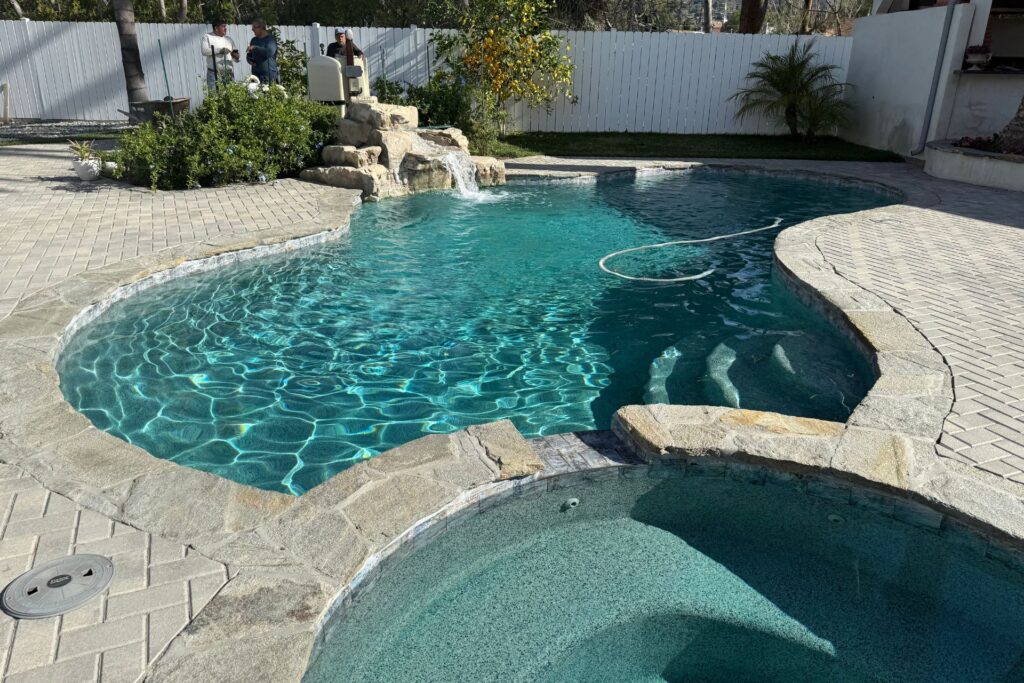
Steps Are One of the First Things Homeowners Want to Change
Older pools often have surprisingly small entry steps.
You walk down two or three narrow steps and suddenly you are in the water.
That may have worked perfectly for the family who built the pool twenty five years ago.
The current homeowner may want something completely different.
Maybe they want wider steps where people can sit.
Maybe they want an entry that feels easier for older family members.
Maybe children spend half their time sitting on the steps anyway, so making them more comfortable would actually improve the way everyone uses the pool.
Changing steps can affect the surrounding pool structure, finish, and sometimes plumbing depending on the design.
But when it makes sense structurally, it can completely change how the pool feels without changing the entire shell.
A Baja Shelf Can Make an Older Pool Feel Much Newer
This is one of the most common ideas homeowners bring up.
“Can we add a Baja shelf?”
Sometimes, yes.
A shallow lounging area can make an older pool feel much more connected to the way families use pools today.
Parents may sit there with younger children.
Adults can put a lounge chair in shallow water.
Someone can cool off without fully swimming.
And, based on what we have seen, the family dog will probably decide the shelf belongs to them.
The important part is understanding what the shelf takes away.
It needs space.
If the existing pool is already compact, adding a very large Baja shelf may reduce the open swimming area more than the homeowner expects.
We like to look at the whole pool before deciding.
Maybe a smaller shelf is perfect.
Maybe wider steps accomplish almost the same thing without using as much room.
The best remodel is not the one with the most new features.
It is the one where the new features make the existing pool more useful.
Built In Seating Can Solve an Awkward Corner
Some pools have corners or curves that nobody really uses.
That does not always mean the shape needs to disappear.
Sometimes we can give that space a job.
Built in seating is a good example.
A bench can create somewhere to relax without adding a large new feature.
It may also make an awkward portion of the pool suddenly feel intentional.
We have seen homeowners get much more use out of a simple bench than they expected.
People sit there during conversations.
Parents use it while watching the kids.
Guests who do not want to fully swim can still stay in the water.
Sometimes the best redesign is not about removing an odd part of the pool.
It is about finding a better use for it.
Changing the Depth Is a Bigger Conversation
Pool depth is another thing homeowners occasionally want to change during remodeling.
Maybe the pool has a deep end nobody uses.
Maybe most of the family wants to stand, play games, and socialize.
Or perhaps the opposite is true and the existing pool feels too shallow for the way they want to swim.
Depth changes may be possible in some pools, but this is not a cosmetic decision.
The structure needs to be evaluated.
Plumbing and drains matter.
The way the pool floor transitions from one depth to another matters.
The size of the existing pool matters too.
A homeowner may picture gaining a large amount of usable space by changing the depth, but the actual project needs to be based on what the existing shell can reasonably support.
That is why reconfiguration starts with evaluation rather than assumptions.
Straightening a Curved Pool Is Not the Same as Drawing a Straight Line
This is where inspiration photos can get a little misleading.
A homeowner may have an older curved pool and fall in love with clean rectangular pools online.
Then they ask whether we can simply straighten the sides.
Sometimes portions of an existing pool can be modified.
But existing pool walls are structural.
Changing them can involve demolition, new steel, new concrete, plumbing changes, coping, tile, decking, waterproofing, and a new interior finish.
At some point, the amount of work required may become large enough that we need to compare remodeling with a more extensive reconstruction.
That does not mean the idea is impossible.
It simply means we should understand what we are gaining.
If changing one side creates a much better deck, improves circulation, and finally makes the yard work, it may be worth considering.
If the only reason is that rectangles happen to be popular right now, we would probably have a longer conversation first.
The Deck Often Tells Us What Needs to Change
One of the best ways to understand an old pool is to stop looking at the water.
Look at the area around it.
Where does furniture fit?
Where do people walk?
Is there an awkward narrow section that nobody uses?
Does the pool sit too close to the main patio?
Is there a corner of the yard that would become much more useful if the pool edge moved?
A pool and its deck are connected.
Changing the pool shape without thinking about the deck can solve one problem and create another.
That is why we often discuss Triton’s Outdoor Living and decking services during larger remodels.
Sometimes reducing one part of the pool gives the backyard enough room for an actual seating area.
Sometimes the pool stays almost exactly where it is and the deck receives most of the attention.
You have to look at both.
Adding a Spa Can Change the Pool Shape Too
A spa addition is another reason homeowners start thinking about reconfiguration.
Maybe the existing pool never had one.
Now the family wants somewhere warm to relax in the evening.
Adding a spa may affect the pool edge, deck, plumbing, equipment, heating, and overall shape.
A raised spa might become a new focal point.
A spa closer to water level may feel more subtle.
Sometimes the best location means changing part of the existing pool.
Other times, keeping the pool untouched and placing the spa beside it creates a much cleaner project.
Again, there is no universal answer.
The property usually tells us what makes sense.
Older Plumbing Can Influence What We Do
Most homeowners never see the pool plumbing.
That does not make it unimportant.
A larger remodel can expose an opportunity to update plumbing that has been in place for many years.
Triton lists plumbing upgrades and structural modifications among its Pool Remodeling services.
If we are already changing steps, adding a spa, modifying the pool structure, or opening sections around the shell, it makes sense to look at what is happening behind the finish.
We do not want to build a beautiful new feature around a plumbing problem that should have been addressed while everything was open.
This is the part of remodeling nobody sees afterward.
It is also the part that can matter for years.
New Tile and Coping Help the Changes Feel Intentional
Structural work creates the change.
Materials make it feel finished.
If part of the pool is being reconfigured, the waterline tile and coping usually become part of the conversation.
That is because older materials can be difficult to match perfectly.
Sometimes the homeowner does not want to match them anyway.
The remodel is the opportunity to finally update the whole look.
Triton offers Pool Tile and Coping services including waterline tile, glass tile, porcelain tile, natural stone, travertine coping, precast coping, and pour in place coping.
When the shape changes and the edge materials are updated together, the finished pool tends to feel much more intentional.
Instead of looking like somebody added a piece later, everything belongs to the same design.
Reconfiguration Usually Means a New Interior Finish Too
Once structural changes are made inside a pool, the existing finish is often affected.
That makes resurfacing a natural part of many larger reconfiguration projects.
Triton’s Pool Resurfacing services include plaster, quartz, mini pebble, pebble, and specialty interior finishes.
This can actually be one of the enjoyable parts of the project.
The homeowner may have started the remodel because the steps were awkward.
Then the project gives them a chance to choose a finish they have wanted for years.
Suddenly the water color changes.
The tile changes.
The pool edge changes.
And the pool they have looked at for twenty years feels completely different.
Some Pools Are Better Candidates Than Others
We would love to say every pool can become any shape a homeowner imagines.
That would not be honest.
The existing structure matters.
The property matters.
Access matters.
Utilities matter.
The amount of structural work matters.
And sometimes the change someone wants would require so much reconstruction that keeping the existing pool stops providing much of an advantage.
That is when we compare options.
Maybe a more limited remodel gives the homeowner almost everything they want.
Maybe a larger reconfiguration is justified.
Or maybe the project has moved close enough to rebuilding that another approach deserves consideration.
The goal is not to force every old pool into a new design.
It is to find the smartest path from what you have to what you want.
Permits May Become Part of the Project
Once a remodel moves beyond finishes and into structural changes, plumbing, electrical work, or significant reconfiguration, permit requirements may become part of the conversation.
For projects within the City of Los Angeles, homeowners can review building and permitting information through the Los Angeles Department of Building and Safety.
Triton also offers Pool Design, Plans and Permits services that include concept development, engineering, plot plans, structural drawings, site evaluation, and permit processing.
We prefer discussing that early.
It is much easier to create a realistic design when everyone understands what the project may require before construction starts.
Do Not Remodel the Pool for the Previous Owner
This is something worth saying.
A lot of homeowners inherit pools.
They buy a house and the pool simply comes with it.
The previous owner may have loved the shape.
They may have wanted a very deep end.
Maybe they did not care about a spa.
Maybe their children were older.
Maybe they entertained differently.
None of that means the pool needs to stay exactly the way they built it.
If you are already investing in a remodel, think about how your family uses the backyard.
Do you want wider steps?
More standing room?
A spa?
A shelf?
More deck?
Less pool?
Better seating?
Those questions matter more than preserving a layout simply because it has been there for decades.
How Triton Pools and Spas Approaches Pool Reconfiguration
At Triton Pools and Spas, we start with what is already working.
Maybe the pool sits in the perfect location.
Maybe most of the shell is worth keeping.
Maybe the size is right but the entry feels awkward.
Maybe one curve steals space from the patio.
Maybe the deep end has not been used properly in years.
We want to understand that before we start drawing anything new.
Then we look at the changes that would actually make the pool better.
Triton’s current remodeling services include pool reconfiguration, spa additions, structural modifications, plumbing upgrades, deck renovations, complete renovations, waterline tile replacement, and equipment modernization.
Sometimes the answer is a major transformation.
Sometimes one or two thoughtful changes are enough.
The point is not to make an old pool unrecognizable.
It is to make it work better for the people who own it now.
Frequently Asked Questions
Sometimes significant changes are possible, but the existing shell, structure, plumbing, property conditions, and scope of work need to be evaluated first. Larger shape changes can require substantial structural reconstruction.
In some pools, yes. The available space, existing structure, depth, steps, and plumbing all influence whether a shelf makes sense and how large it should be.
It may be possible depending on the pool. Depth modifications can involve structural work and changes to the pool floor, plumbing, drains, and interior finish.
Yes, spa additions are one of Triton’s listed remodeling services. The best location depends on the pool, equipment, deck, plumbing, and overall backyard design.
Structural changes often affect the existing interior finish, so resurfacing commonly becomes part of larger reconfiguration projects.
It depends on how much of the existing pool can be kept. A limited reconfiguration may be very different from a project involving extensive demolition and structural reconstruction.
Before You Decide the Whole Pool Needs to Change
Walk around it one more time.
What actually bothers you?
Is it really the curve?
Or is there nowhere to put a chair?
Do you really need a completely different shape?
Or would wider steps and a Baja shelf change everything?
Does the deep end need to disappear?
Or does the family simply need more comfortable seating?
Sometimes homeowners start by saying,
“We want a different pool.”
After talking for a while, they realize something else.
They want the pool they already have to finally fit the way they live.
And when the existing structure gives us something worth working with, that can be a very good place to start.